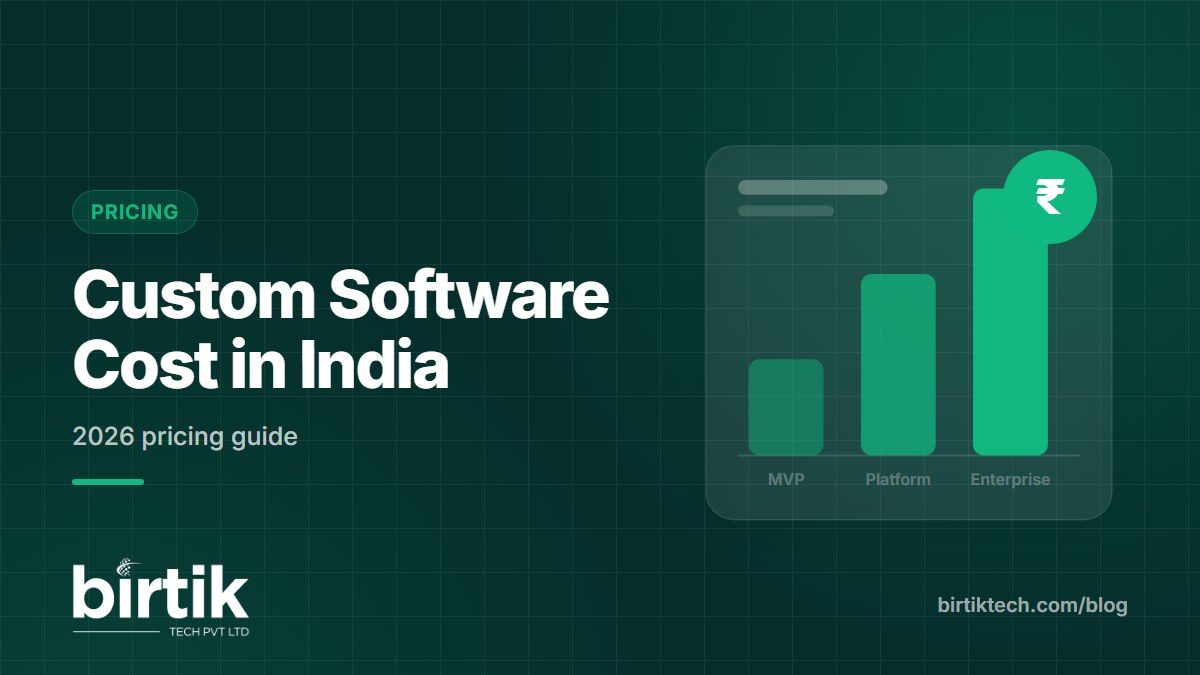
Custom software in India typically costs ₹6–12 lakh for a focused MVP, ₹15–40 lakh for a production-grade SaaS or operations platform, and more for enterprise systems with heavy compliance and integrations. An MVP usually ships in 12–18 weeks and a full v1 in 5–8 months. Scope, integrations and team shape decide where you land in those ranges.
Those are the ranges we publish on our custom software development page, and they match what we see across real Indian projects. The rest of this guide explains what moves a project up or down a band, what costs sit outside the build quote, and how to get an estimate you can actually budget against.
Custom software cost in India at a glance
| Tier | What it usually includes | Typical cost | Typical timeline |
|---|---|---|---|
| Focused MVP | One or two user roles, core workflow, login, basic admin, one or two integrations | ₹6–12 lakh | 12–18 weeks |
| Production platform or SaaS v1 | Multiple roles, billing, reporting, 3–5 integrations, monitoring and backups | ₹15–40 lakh | 5–8 months |
| Enterprise system | Complex permissions, audit trails, compliance, ERP or banking integrations, high availability | ₹40 lakh and above | 9–15 months |
Treat these as planning bands, not quotes. Two projects with the same feature list can differ by 2x because of how messy the integrations are or how strict the uptime target is.
The seven things that actually drive the price
Most founders compare quotes by counting screens. Screens are rarely what makes software expensive. These seven levers are.
1. Number of user roles and workflows
Every role (customer, staff, manager, admin, vendor) brings its own permissions, screens, notifications and edge cases. A two-role tool is a different project from a five-role platform, even if both “have a dashboard”.
2. Integrations
Payment gateways, ERPs, CRMs, KYC providers, WhatsApp, maps, accounting tools. Each one needs error handling, retries and testing against a sandbox that often behaves differently from production. A clean, well-documented API is cheap to connect. A legacy system with no API can cost more than the rest of the MVP.
3. Compliance and data rules
Health, finance and anything holding children’s data carries extra work: audit logs, consent records, encryption, data retention rules. India’s Digital Personal Data Protection Rules were notified in November 2025 with an 18-month phased rollout, so new systems should be built with consent and data-deletion flows from day one rather than retrofitted.
4. Platforms
Web only, web plus Android and iOS, or a desktop app as well. A shared backend helps, but every extra client is real work in design, testing and releases.
5. Data migration
Moving years of records out of spreadsheets or an old system is often underestimated. Cleaning duplicates, mapping fields and reconciling totals takes time that does not show up on a feature list.
6. Design depth
An internal tool can use a clean component library. A consumer product competing on experience needs research, custom UI and more iteration. Both are valid; they are priced differently.
7. Non-functional requirements
Expected users, uptime target, response times, backup and recovery, security testing. “It must never go down” is one of the most expensive sentences in a brief, so state the real target.
Fixed scope or dedicated team: how you pay changes what you pay
There are two common ways to buy custom software in India.
- Fixed scope, milestone-based. You agree a written scope and pay against milestones. Best when the product is well defined. The risk is change requests: anything outside the scope becomes a new estimate.
- Dedicated engineers or a squad. You pay monthly for a team and move the roadmap as you learn. Best for products that will keep evolving. For reference, our published rates for full-time dedicated engineers start at ₹1.6–1.7 lakh a month, and squads of 3–6 engineers with a tech lead start at ₹6.5–6.8 lakh a month, depending on the stack. See hire developers for the current tiers.
Many projects use both: a fixed-scope MVP first, then a dedicated team once real users start shaping the roadmap.
Costs that sit outside the build quote
A development quote covers building the software. Budget separately for running it.
- Hosting. Cloud bills scale with usage. If you need data to stay in India, AWS has two regions here: Mumbai (ap-south-1) and Hyderabad (ap-south-2).
- Third-party services. Email, SMS, maps, search, error monitoring and AI APIs are usually billed per use.
- Payment fees. Razorpay’s standard plan, for example, charges a 2% platform fee on domestic cards, UPI, netbanking and wallets, with 18% GST on that fee.
- App store accounts if you ship mobile apps: Apple charges USD 99 per year and Google Play a one-time USD 25.
- GST. Software development services are taxed at 18% in India. Exports of services to clients outside India are zero-rated when the vendor supplies under a Letter of Undertaking.
- Maintenance. Security patches, dependency upgrades, OS and browser changes and small fixes never stop. Plan for a monthly retainer after the warranty period.
How to get an estimate you can trust
- Write a one-page brief. Who the users are, the three jobs the software must do, the systems it must connect to, and your launch date. Skip the feature wishlist.
- Ask for a discovery step. A short call or workshop where the vendor asks hard questions is worth more than a quick quote. Any number given before discovery is a guess.
- Insist on a written, milestone-based estimate. Each milestone should name what you will be able to use at the end of it.
- Compare like with like. Check that every quote includes testing, deployment, monitoring, documentation and a warranty period.
- Agree how changes are priced before you sign, not after the first change request.
Red flags in a software quote
- A firm price after a ten-minute call, with no questions about integrations or users.
- No mention of testing, staging, or who owns the hosting accounts.
- Source code that stays on the vendor’s servers instead of your own repository.
- No intellectual property assignment in the contract.
- One lump-sum payment instead of milestones tied to working software.
- A team you never meet, or “senior developers” with no named tech lead.
Is custom software worth it?
Sometimes it is not. If an off-the-shelf tool covers 80% of the need, start there and build only the part that gives you an edge. Custom software pays off when your workflow is genuinely different, when SaaS workarounds cost more than building, or when the data and IP should belong to you. Our SaaS vs custom software comparison walks through that decision.
If you want a number tied to your actual scope, book a free discovery call and we will send a written, milestone-based estimate.
Frequently asked questions
How much does a software MVP cost in India?
A focused MVP with one or two user roles, a core workflow and a basic admin typically costs ₹6–12 lakh and ships in 12–18 weeks. MVPs with payments, KYC or several integrations cost more.
Why do software quotes in India vary so much?
Vendors quote against different assumptions. One may include testing, monitoring and a warranty; another may quote screens only. Unclear integrations and missing non-functional requirements are the biggest source of gaps between quotes.
Is it cheaper to hire freelancers than a software company?
The hourly cost is often lower, but you take on project management, code review, testing and continuity risk yourself. For anything business-critical, compare the total cost including those roles, not just the rate.
Do I have to pay GST on software development?
Yes, software development services in India are taxed at 18% GST. Clients outside India are generally not charged GST because exports of services are zero-rated.
How much should I budget for maintenance?
Plan a monthly retainer for security patches, upgrades and small improvements once the warranty period ends. The amount depends on how much the product keeps changing and how many integrations it has.
Who owns the code?
You should. Make sure the contract includes an IP assignment clause and that the code lives in a repository you control from the first commit.